From Messy to Meaningful: 5 Foreign Data Prep Tools Every Analyst Should Know
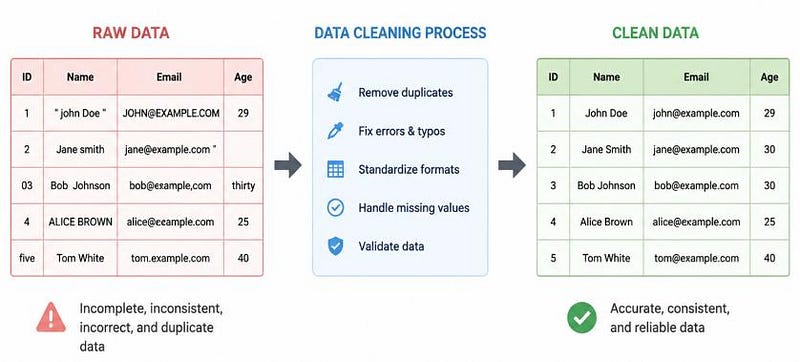
Data cleaning is one of the most time-consuming parts of data analysis and machine learning. Studies suggest that data analysts spend roughly 60% of their time dealing with messy, inconsistent data — and the right tool can cut that effort by 30% to 50%. If you’re exploring foreign tools for data preparation, these five established options span a wide range of use cases, from open-source desktop applications to enterprise-grade cloud platforms.
1. OpenRefine: The Classic Open-Source Desktop Cleaner
OpenRefine, formerly known as Google Refine, is a free, open-source desktop application that has earned a loyal following among researchers and anyone who needs fine-grained control over smaller datasets.
Its standout feature is powerful text clustering and transformation. When your data contains inconsistent country names like “USA,” “U.S.A.,” and “us,” OpenRefine can automatically group these variants using fingerprint algorithms or n-gram methods, allowing you to standardize them with a single click. The faceted browsing and real-time preview let you spot outliers and anomalies as if you were working with a sophisticated pivot table — and every action you take can be undone or reviewed step by step.
That said, OpenRefine works best with datasets up to a few hundred thousand rows, where hands-on, exploratory cleaning is the goal. Because it processes everything in local memory, performance degrades noticeably with larger volumes. It also lacks built-in scheduling features, so it’s not ideal for automated daily cleaning routines.
2. Trifacta Wrangler (Now Alteryx Designer Cloud): AI-Powered Cloud Cleaning
Trifacta made its name as a pioneer in data preparation, and after being acquired by Alteryx, its technology now lives on in Alteryx Designer Cloud. The product focuses on intelligent, assisted cleaning delivered through the cloud.
The main draw is its AI-driven transformation suggestions. Once you load a messy dataset, Trifacta automatically scans for patterns and recommends specific cleaning actions — fixing date formats, handling null values, or standardising text — so you can approve or adjust them with minimal effort. Every operation you confirm is saved as a reusable “recipe,” meaning you can apply the same cleaning logic to new incoming data in one click.
This makes Trifacta an excellent fit for analyst teams who work with larger cloud-based datasets and value speed, especially if they use cloud data warehouses like BigQuery. However, the AI suggestions still require human review to avoid unintended changes, and the streaming workflow lacks strict version control for collaborative editing.
3. AWS Glue DataBrew: A Cloud-Native, No-Code Data Prep Service
For organisations already invested in the AWS ecosystem, AWS Glue DataBrew offers a compelling option. It is a fully managed, no-code visual data preparation service that requires no infrastructure setup.
DataBrew provides over 250 built-in transformations, covering filtering, format conversion, standardisation, and anomaly handling — all accessible through simple clicks. More importantly, it automatically profiles your data to generate quality insights and integrates with AWS data lineage services, giving you clear visibility into where your data comes from and how it has been transformed. Cleaned results can be fed directly into analytics or machine learning pipelines.
This tool fits seamlessly into organisations that have built their data lake or warehouse on AWS, empowering analysts and data scientists to clean data without relying on engineers. The trade-off is vendor lock-in, and the preset transformations may fall short if your cleaning logic is unusually complex or custom.
4. Alteryx: A Drag-and-Drop Data Workshop for Business Analysts
Alteryx is widely regarded as a gold standard for complex data preparation without coding, often positioned as a powerful upgrade to Excel.
Its workflow is built around an intuitive drag-and-drop canvas. You assemble cleaning steps by dragging tools onto the workspace — filter, join, aggregate, fuzzy-match deduplication — and connecting them to form an automated pipeline. What sets Alteryx apart is its strength in spatial analytics and predictive preparation, making it particularly useful when your data involves geographic information or when you need to run lightweight predictive models during cleaning.
Alteryx is ideal for business analysts and data scientists who want to prepare data quickly without writing code. The downside is its relatively high licensing cost, and performance can become a bottleneck when processing extremely large datasets.
5. Tableau Prep: Cleaning That Flows Straight into Visualisation
If your organisation already relies on Tableau for reporting and dashboards, Tableau Prep is a natural addition to your workflow.
Designed with the same visual philosophy as Tableau Desktop, Tableau Prep emphasises immediate visual feedback. As you clean, you can see colour-coded distributions and histograms update in real time, so you always understand the impact of each operation. It also intelligently suggests corrections for spelling inconsistencies and common typos. Perhaps most importantly, cleaned data can be output directly as a Tableau data source, eliminating the tedious export-import cycle when building dashboards.
This makes Tableau Prep a great choice for analysts in marketing, operations, or other business functions who work heavily within the Tableau ecosystem. However, it does not support custom code extensions, and performance can be underwhelming when dealing with complex multi-table joins or very large volumes.
How to Choose the Right Tool
Selecting the best data cleaning tool depends largely on your context, team, and existing infrastructure.
- If you’re working on academic research, have a tight budget, or handle sensitive data that must stay on-premises, OpenRefine is a safe and capable starting point — though you’ll outgrow it as data scales.
- If your data already lives in the cloud and your team values speed and collaboration, tools like Trifacta (Alteryx Designer Cloud) or AWS Glue DataBrew offer smart automation and seamless integration with cloud warehouses.
- If your organisation relies heavily on business analysts who prefer visual, no-code workflows, Alteryx provides one of the most mature and comprehensive environments for complex data preparation.
- And if your analytics pipeline is already built around Tableau, Tableau Prep delivers the smoothest possible transition from raw data to polished dashboards.
Ultimately, there is no single “best” tool — only the one that best fits your data volumes, team skills, and existing technology stack. The five options above represent some of the most respected foreign tools on the market, and each excels in its own niche.


评论
发表评论